
Tikka CTR vs. TAC A1: Which Precision Rifle Should You Buy in Canada?
Sep
Both the CTR and the TAC A1 exist for the same reason: to give Tikka T3x shooters more precision capability than a standard hunting rifle offers. But they solve that problem in very different ways, at very different weights and price points, and picking the wrong one means either overpaying for adjustability you won’t use or under-buying and wanting more within a season. Here’s the direct comparison.
Tikka CTR vs. TAC A1 at a Glance
| Spec | CTR | TAC A1 |
|---|---|---|
| Stock/chassis | Synthetic stock, adjustable cheekpiece | Full aluminum chassis, folding stock |
| Weight | ~7.5–8 lbs unscoped | ~10–11 lbs unscoped |
| Trigger | Single-stage, adjustable | Two-stage, adjustable |
| Muzzle | Threaded 5/8×24, standard | Threaded 5/8×24, often includes brake |
| Magazine | 10-round detachable | 10-round detachable steel |
| Calibers | .223 Rem, .243 Win, .260 Rem, 7mm-08 Rem, .308 Win, 6.5 Creedmoor | .308 Win, .260 Rem, 6.5 Creedmoor |
| Aftermarket fit | Standard T3x pattern | AR-compatible grip & buffer tube |
| Best for | Stepping up from a hunting rifle | Dedicated precision / PRS-style shooting |
The Core Difference: Stock vs. Chassis
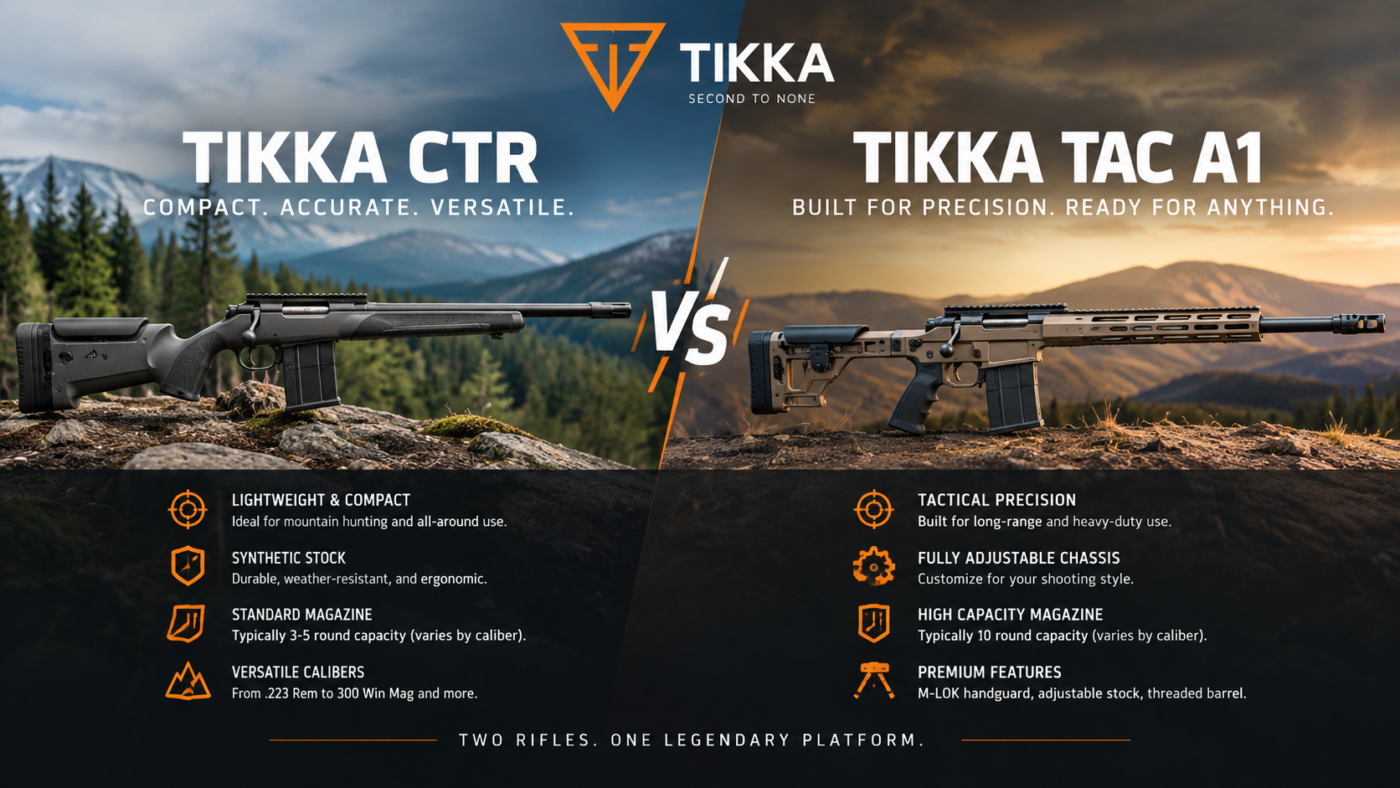
Everything else in this comparison flows from one decision Tikka made at the design stage. The CTR keeps a traditional synthetic stock and simply adds precision-oriented features to it and an adjustable cheekpiece, a threaded barrel, a higher-capacity magazine. The TAC A1 removes the stock entirely and replaces it with a machined aluminum chassis: a folding stock, independently adjustable cheekpiece and length of pull, and an M-LOK handguard with a full-length top rail. If you want the feel and adjustability of a true chassis rifle, only the TAC A1 delivers that. If you want most of the practical benefit without the added bulk, the CTR gets you there.
Tikka CTR vs. TAC A1: Weight & Portability
This is where the two rifles diverge most in daily use. At roughly 7.5–8 lbs, the CTR is still light enough to carry on a hunt without feeling like a burden. The TAC A1, at 10–11 lbs unscoped, is built primarily for bench, bipod, or prone shooting. It’s not a rifle most people want to carry miles into the field. If you split your time between hunting and precision shooting, that weight difference alone often decides the question.
Trigger: Single-Stage vs. Two-Stage
The CTR uses a single-stage trigger, adjustable within roughly the same 2–4 lb range as the rest of the T3x lineup, press and it breaks. The TAC A1 steps up to a two-stage trigger: a light take-up stage followed by a distinct wall before the break. Two-stage triggers are generally preferred for precision and long-range work because that wall gives you a more predictable, repeatable break, which matters more the further out you’re shooting.
Tikka CTR vs. TAC A1: Caliber Selection
The CTR offers a noticeably wider caliber range, six options including lighter-recoiling choices like .223 Rem and 7mm-08 Rem alongside .308 Win and 6.5 Creedmoor. The TAC A1 is narrower by design, limited to .308 Win, .260 Rem, and 6.5 Creedmoor, all chosen specifically for precision and long-range performance rather than general-purpose use. If you want a caliber outside that trio, the CTR is the only one of the two that offers it.
Tikka CTR vs. TAC A1: Adjustability & Fit
The CTR’s adjustable cheekpiece lets you set consistent eye alignment with your optic, which covers most of what a growing precision shooter actually needs. The TAC A1 goes further: independently adjustable cheekpiece height and angle, tool-adjustable length of pull, and a folding stock for storage and transport. For a shooter who’s still figuring out their exact position and setup, that extra adjustability on the TAC A1 can genuinely shorten the learning curve.
Tikka CTR vs. TAC A1: Aftermarket Compatibility
Because the TAC A1’s chassis uses an AR-15-pattern grip and buffer tube, it opens the door to a huge range of aftermarket grips, stocks, and accessories if you want to customize further. The CTR’s synthetic stock is more limited in that regard, though it shares the same action as the rest of the T3x lineup, so any aftermarket support built around the Tikka T3 action still applies.
Tikka CTR vs. TAC A1: Which Should You Buy?
Choose the CTR if:
- You want to step up from a standard hunting rifle without maximizing cost or weight
- You want the flexibility of a wider caliber selection
- You still want a rifle light enough to comfortably hunt with
Choose the TAC A1 if:
- You’re serious about precision or PRS-style shooting and know you’ll use the extra adjustability
- Weight isn’t a major concern because the rifle stays mostly on a bench, bipod, or in prone position
- You want AR-pattern aftermarket compatibility for future customization
There’s also a middle option worth knowing about: the UPR sits between these two, adding an adjustable cheekpiece and butthook to a lighter fiberglass stock rather than a full chassis. We cover it in our Best Tikka T3x Models in Canada roundup if neither the CTR nor the TAC A1 feels like an exact fit.
Tikka CTR vs. TAC A1: Frequently Asked Questions
Is the TAC A1 more accurate than the CTR? Both carry the same sub-MOA factory accuracy guarantee. The TAC A1’s chassis and two-stage trigger make it easier to shoot to that potential consistently at longer range, but the CTR isn’t inherently less accurate.
Can I hunt with a TAC A1, or is it strictly a range rifle? You can, but its weight makes it a less practical choice for a rifle you’re carrying all day compared to the CTR.
Is there a middle ground between the CTR and TAC A1? Yes, the UPR was built specifically to fill that gap, with more precision-focused features than the CTR but less weight and cost than the TAC A1.
Which has less felt recoil? The TAC A1’s extra weight generally translates to less felt recoil in the same caliber, since more mass absorbs more of the rifle’s rearward movement.
Can I upgrade a CTR to chassis-like performance later? Not directly, the CTR’s stock isn’t designed to convert into a chassis. If you think you’ll eventually want full chassis adjustability, it may be worth starting with the TAC A1 or UPR instead.
Shop the CTR or TAC A1 in Canada
Both rifles are in stock now. Current pricing and availability for each are kept up to date on their product pages.
Pingback: Tikka T3x Canada: Complete Buyer's Guide to Every Model
Pingback: Tikka T3x TAC A1 Canada: Specs & Buying Guide